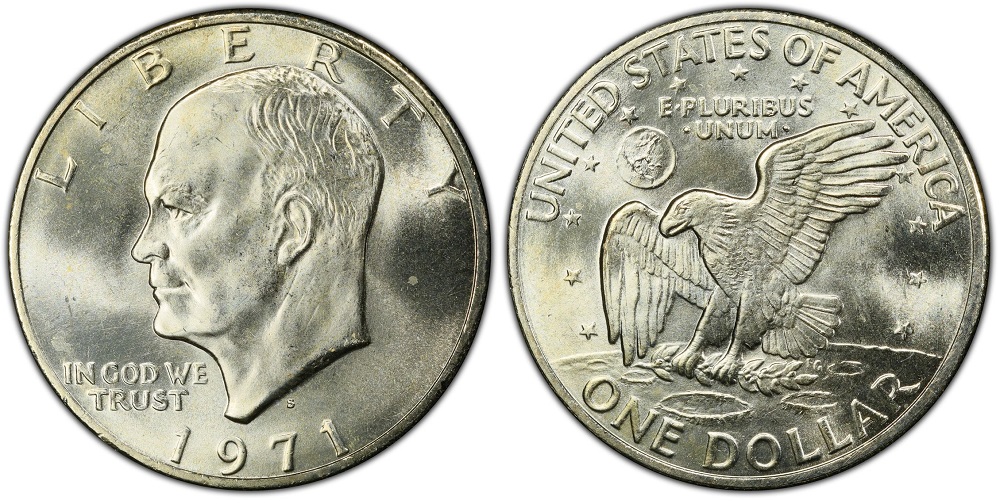
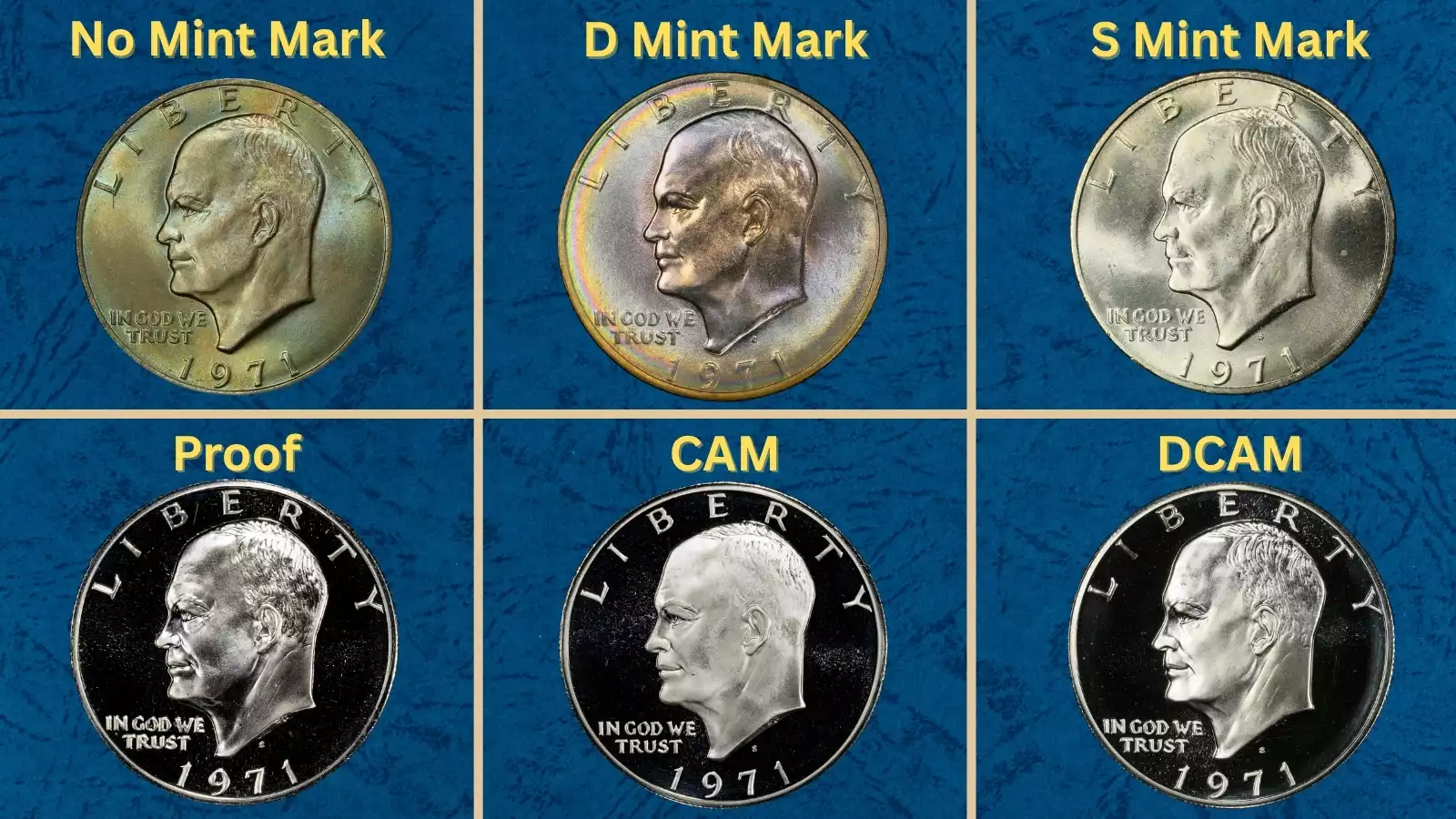
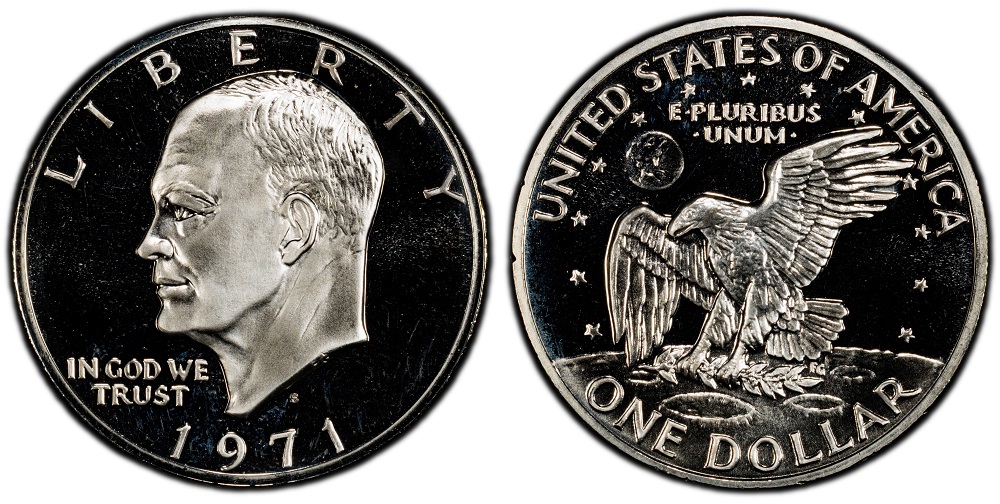
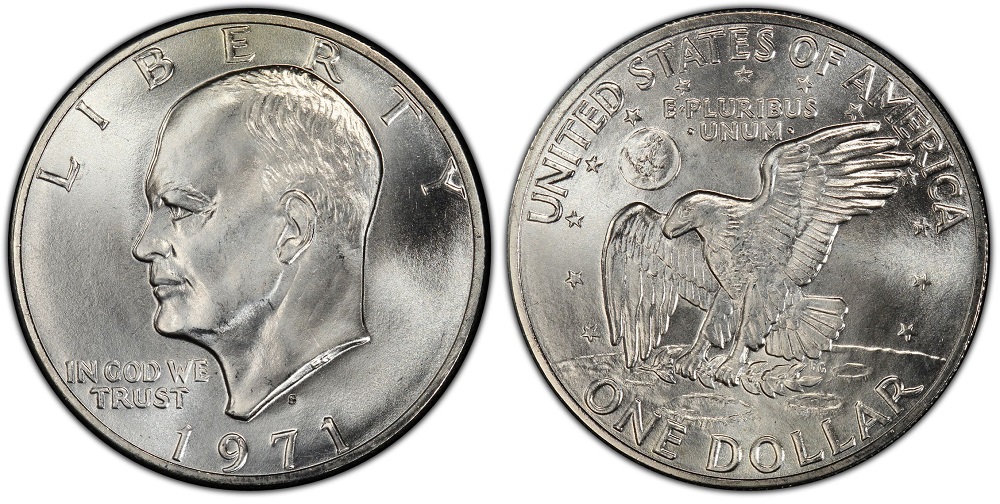
The 1971 Eisenhower dollar series produced several notable die varieties and mint errors. Because the silver S-mint issues were handled as collector coins — not circulated — even minor die states are well-documented and tracked by PCGS and NGC population reports. The five varieties below appear in descending order of collector demand. Each has its own diagnostic fingerprints; use a quality 10× loupe for the best results.
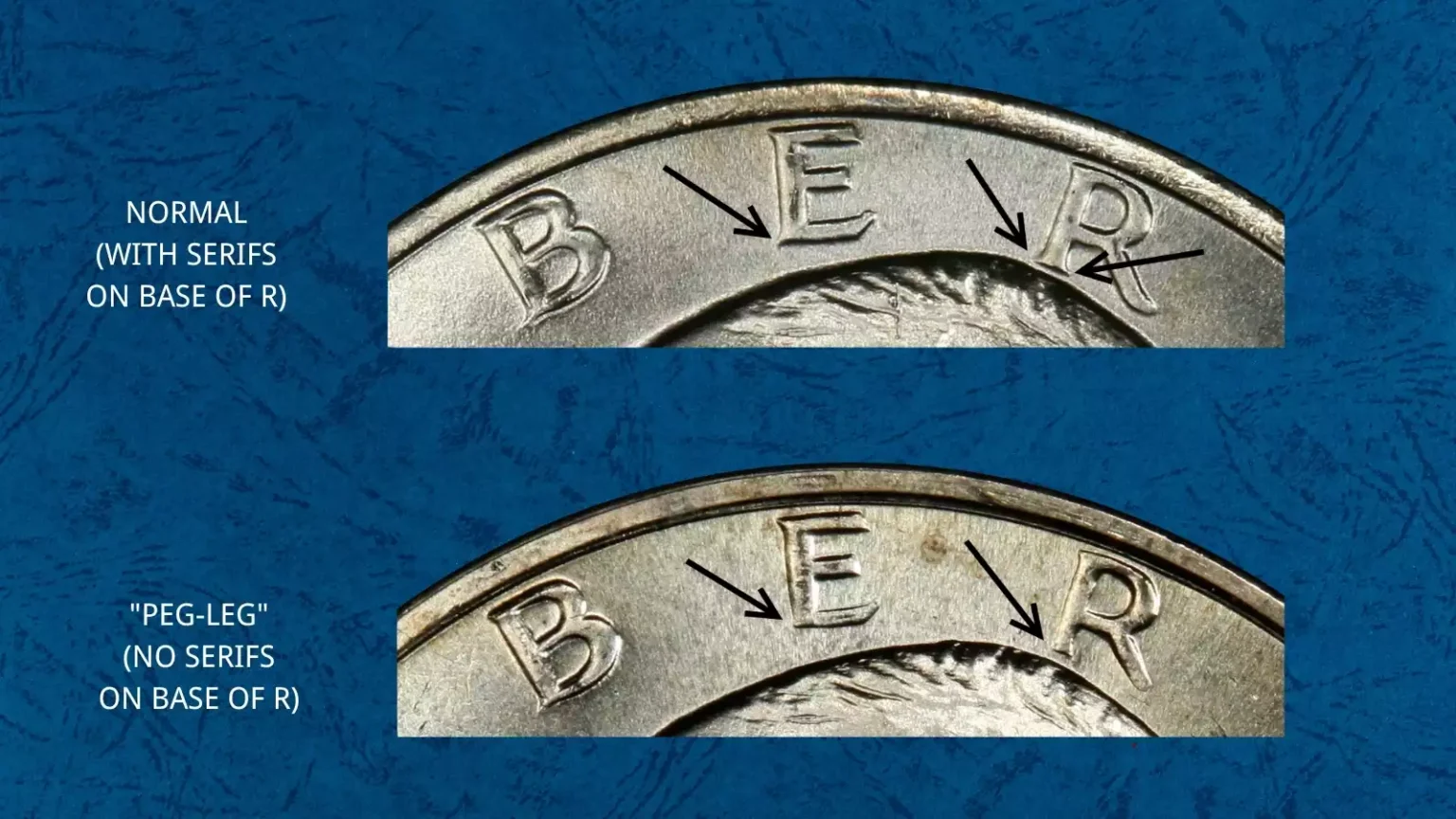
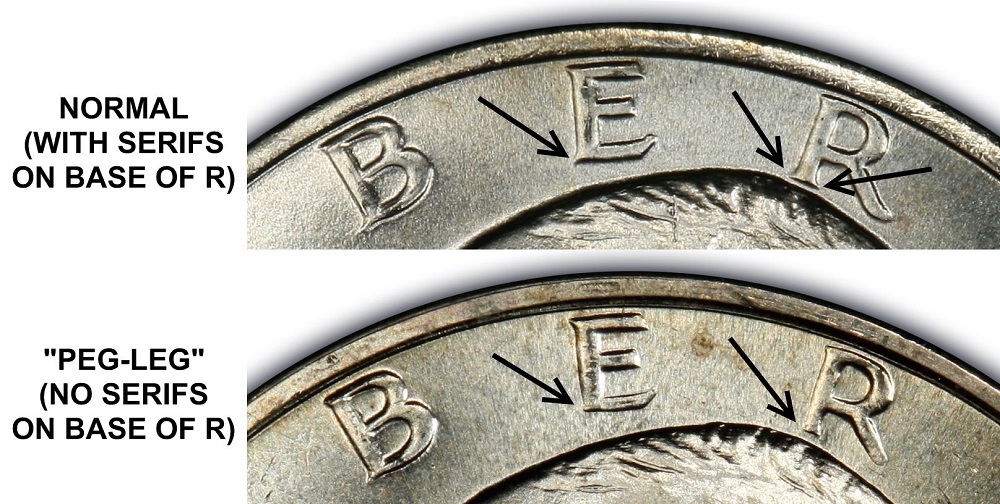
The Peg Leg variety is the most widely recognized die variety in the entire Eisenhower dollar series. It originated at the San Francisco Mint when workers over-polished the obverse die to remove surface defects, inadvertently grinding away both serifs from the letter R in LIBERTY. The result is a characteristic blunt, square-bottomed R that looks like a wooden peg leg rather than the normal tapered serif form.
Under a 10× loupe, the standard R shows two small horizontal extensions — serifs — at the base of its vertical stroke. The Peg Leg R has none; the bottom is perfectly flat and blunt. NGC requires both upper and lower serifs to be absent for the full FS-401 designation, and PCGS tracks it as a distinct variety under PCGS #7408. Partial peg-leg examples (one serif removed) exist but do not qualify.
Despite its notoriety, the Peg Leg is not exceedingly scarce in lower grades — enough examples exist that prices in circulated condition start around $20–$50. The premium accelerates sharply at gem mint-state levels, where careful die-state analysis and population reports determine fair market value. Collectors prize MS66 and above examples because die polish marks become increasingly visible at those grades, adding a secondary layer of difficulty.
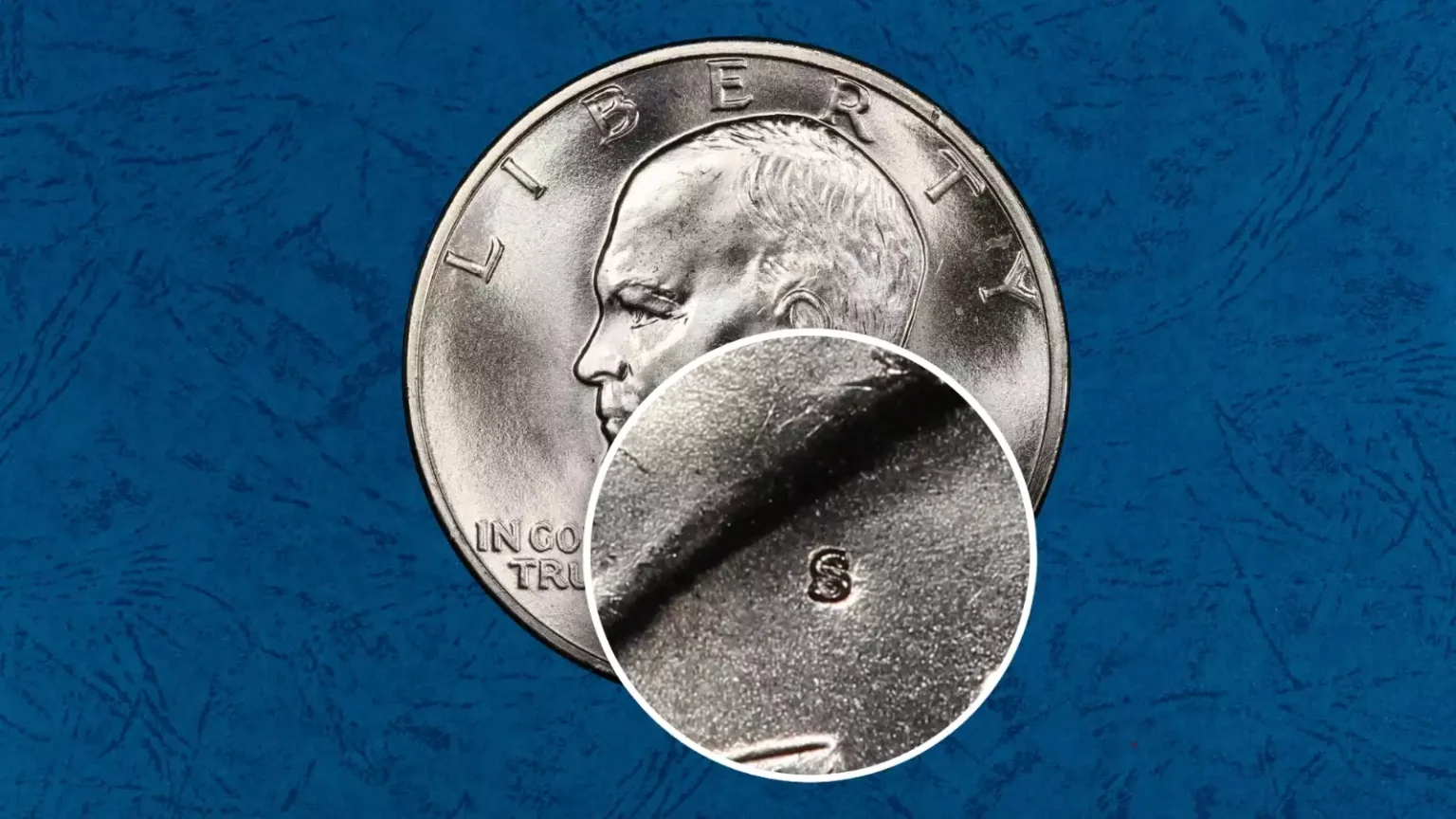
The Repunched Mint Mark (RPM) error on the 1971-S silver dollar is the most valuable regular variety in the series. It occurred during die preparation when the mint mark punch was applied to the working die in a slightly different position on a second impression, leaving a visible secondary S beneath and slightly left of the primary S. The PCGS catalogues this as FS-501 and it remains among the most coveted Eisenhower dollar varieties.
Under magnification, the secondary S is clearly visible as a ghost impression beneath the main mint mark. The lower curve of the secondary S is most prominent. Because these dies were used for the 40% silver uncirculated strikes — produced with greater care than clad circulation issues — the variety is well-documented across a wide grade range. The repunching is not visible to the naked eye and requires at minimum a 5× loupe, preferably 10×.
The premium for this variety accelerates dramatically in higher mint-state grades. A PCGS MS67-graded example realized $8,812 at Heritage Auctions — a significant multiple over the value of a standard 1971-S silver dollar in the same grade. Even MS63 examples command two to three times the baseline price. The RPM variety is confirmed by the Greysheet Catalog (GSID) with CPG values between $13.50 and $8,750 across all grade ranges.
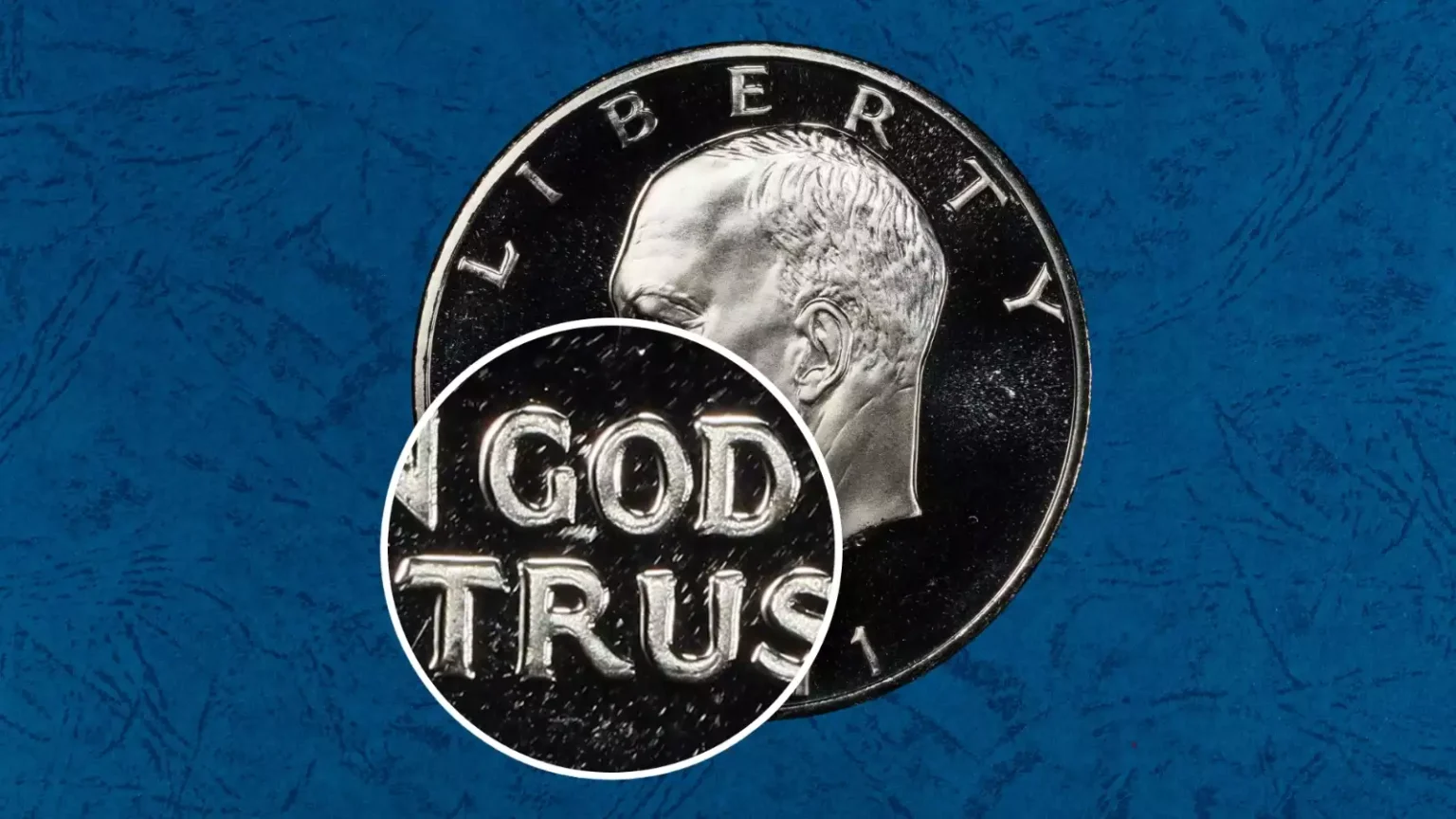
Doubled Die Obverse errors on the 1971-S silver dollar result from a hub-doubling event during die creation. When the working die receives multiple impressions from the hub at slightly different rotational positions, the design elements are duplicated in a shifted or spread pattern. On the 1971-S, the most commonly noted doubling appears in the motto IN GOD WE TRUST, particularly the letters "WE" and portions of "IN GOD," as well as along the hairlines of Eisenhower's portrait.
At least one Type 1 variety has been documented with measurable separation of doubled elements, confirmed by PCGS attribution under FS-106. The doubling is most prominent on proof strikes because the high-polish dies and strong proof pressures sharpen the doubled impressions. Circulated business-strike examples also exist, though the separation is somewhat less dramatic. Collectors use a loupe to check the motto lettering for shadowing or shifted outlines.
The value of doubled die examples depends heavily on the degree of visible separation and the coin's grade. A PR67 deep-cameo proof example with DDO sold at auction for nearly $1,400. Business-strike doubles in uncirculated condition typically bring $30–$100 over base value, depending on grade and the sharpness of the doubling. Coins attributed and slabbed by PCGS or NGC for FS-106 command a significant premium over unattributed raw examples.
The 1971-S Proof double obverse strike is one of the most visually dramatic errors in the Eisenhower dollar series. It occurs when a planchet is struck a second time by the obverse die after moving slightly within the collar. The result is a coin bearing two complete or partial impressions of the obverse design, offset from each other, creating a ghosted duplicate of Eisenhower's portrait and the surrounding inscriptions.
On the most studied example of this error, collectors can see a second outline of Eisenhower's head emerging from behind his bust near the neck truncation, along with duplicated elements of the motto "IN GOD WE TRUST." The "WE" portion is particularly prominent in its doubled form. ANACS graded the most famous documented example as PR63, confirming it as a proof strike — extraordinary because proof planchets are individually fed and handled, making this type of mechanical error especially unexpected and rare.
The collector premium for dramatic die errors on proof coins is substantial. The ANACS PR63 example would have been worth approximately $12 as a normal proof but realized nearly $4,000 at auction with the error — a premium of over 300 times. Because proof production involves close quality control, any error that escaped the mint's screening process represents a significant rarity. Only a tiny number of examples are publicly documented for this specific error type on 1971-S silver proof coinage.
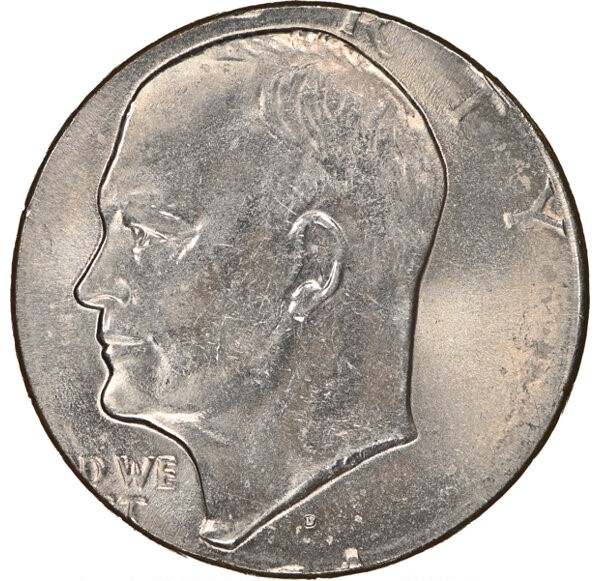
The 1971-D struck-on-wrong-planchet error is among the most spectacular mechanical errors in the Ike dollar series. It occurs when a clad half dollar planchet — intended for a Kennedy half dollar — was accidentally fed into the Eisenhower dollar press at the Denver Mint. Because the half dollar planchet is smaller in diameter (30.6mm vs 38.1mm for the Ike), the full Eisenhower dollar design cannot be contained, and the coin's outer design elements are truncated by the collar and edge.
The result is a coin that shows a complete, correctly struck Eisenhower dollar design in the central portions, but with the peripheral design elements — portions of the motto, the date, and the stars — cut off or missing entirely because the smaller planchet could not accommodate them. The coin also weighs significantly less than a standard Ike: the half dollar planchet weighs approximately 11.34 grams versus 22.68 grams for a normal clad Ike dollar, making the weight discrepancy immediately apparent on a precision scale.
An MS64-graded example of the 1971-D half-dollar planchet error sold for $2,160 at Heritage Auctions — a dramatic multiple over the value of a regular 1971-D dollar in the same grade. These wrong-planchet errors have been verified by PCGS and NGC and represent genuine mint errors with documented auction histories. Their dramatic visual impact — the truncated design is obvious even without magnification — makes them particularly appealing to error coin collectors and general numismatists alike.